
The pH truth
Same bottle. Different water.
A finished pH reading needs its starting water and dose beside it. These exploratory readings show how differently the same product can behave in two water samples.
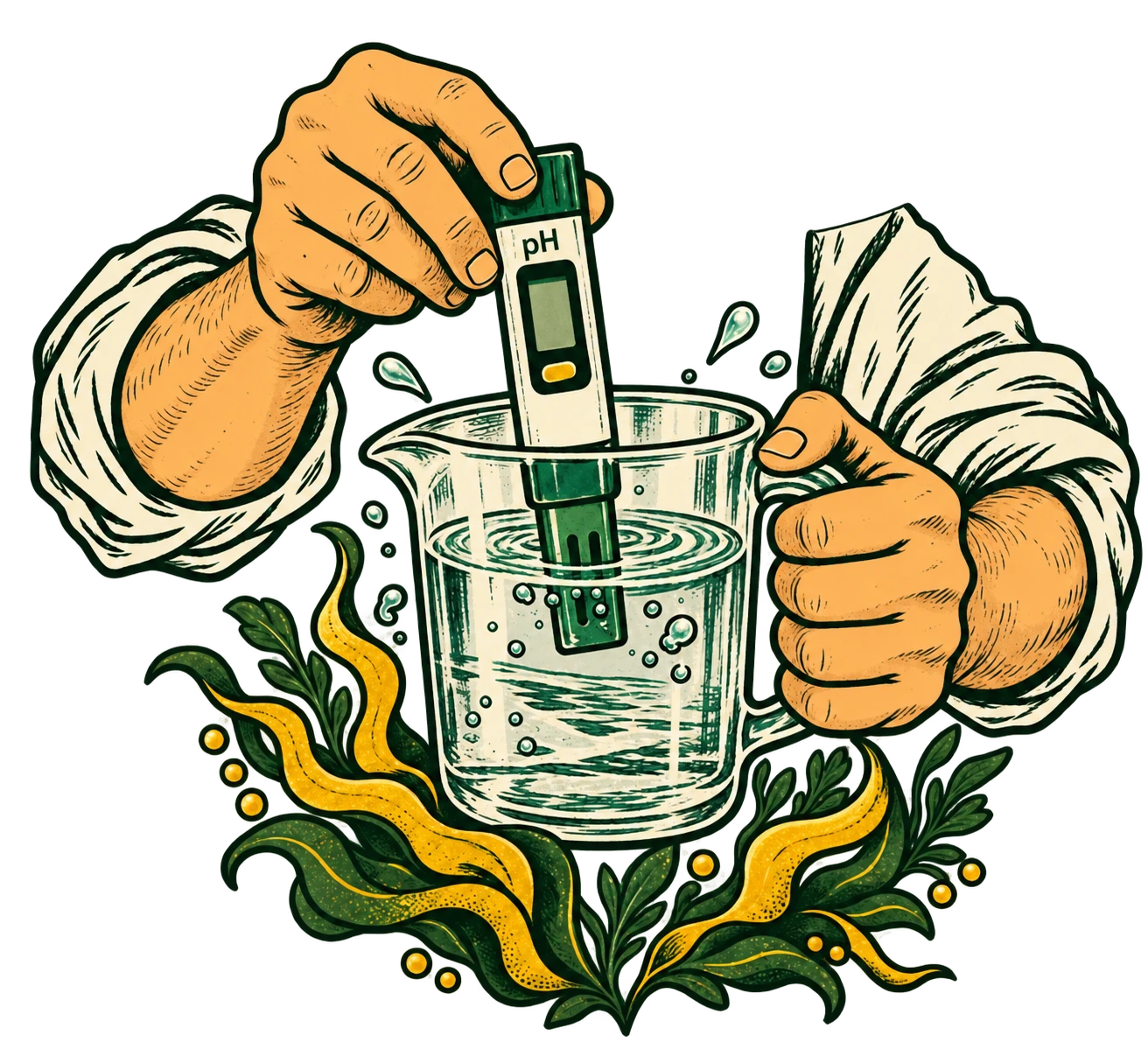
Our numbers
Same bottle. Same dose. Two answers.
We put each product in one litre of purified water and one litre of tap water and measured. Here’s what the same dose does in two different waters.
| Product & dose | Purified water | Tap water | Gap | What it means |
|---|---|---|---|---|
| ÉLAN 1 ml/L | 6.1 | 7.6 | 1.5 | Barely moves pH. Your water decides where you land. |
| UPTHRIVE 2 ml/L | 5.1 | 6.8 | 1.7 | Mildly acidic. Pulls hard water down toward range. |
| PROSPER 4 ml/L | 4.3 | 6.4 | 2.1 | The most acidic in the line. In RO water, measure and adjust. |
| SPARK 3 ml/L | 6.4 | 7.7 | 1.3 | Close to neutral. |
| KICKOFF 1 g/L | 7.0 | 7.5 | 0.5 | Weekly at 0.5 g/L, a small effect in the root zone. |
Starting pH: purified 6.1 to 6.3, tap 7.5 to 7.8. Single products, not a full mix. We’re repeating these with calibrated, dated readings and the full chart mix. See every reading.
Our rule
Organic. Still chemistry. Measure it.
Living soil buffers pH. That’s a reason you might not need to adjust every watering. It’s not a reason to never measure. You only know your soil is handling it if you check.
And the starting pH isn’t the whole story. Two waters at pH 8 can behave completely differently, because of alkalinity: how much acid it takes to move them.
Three steps
- Measure your water. pH, and ask your water supplier or a lab for alkalinity and hardness once.
- Measure your finished mix. All products in, stirred, then read. Write it down.
- Check the root zone now and then. Runoff or a pour-through, the same way every time.
In soil, aim the finished feed roughly at 6.0 to 7.0; in coco and soilless, roughly 5.8 to 6.3. Adjust only when your readings say so.
Go deeper.
Every reading, every element, and how pH changes what each nutrient can do.