
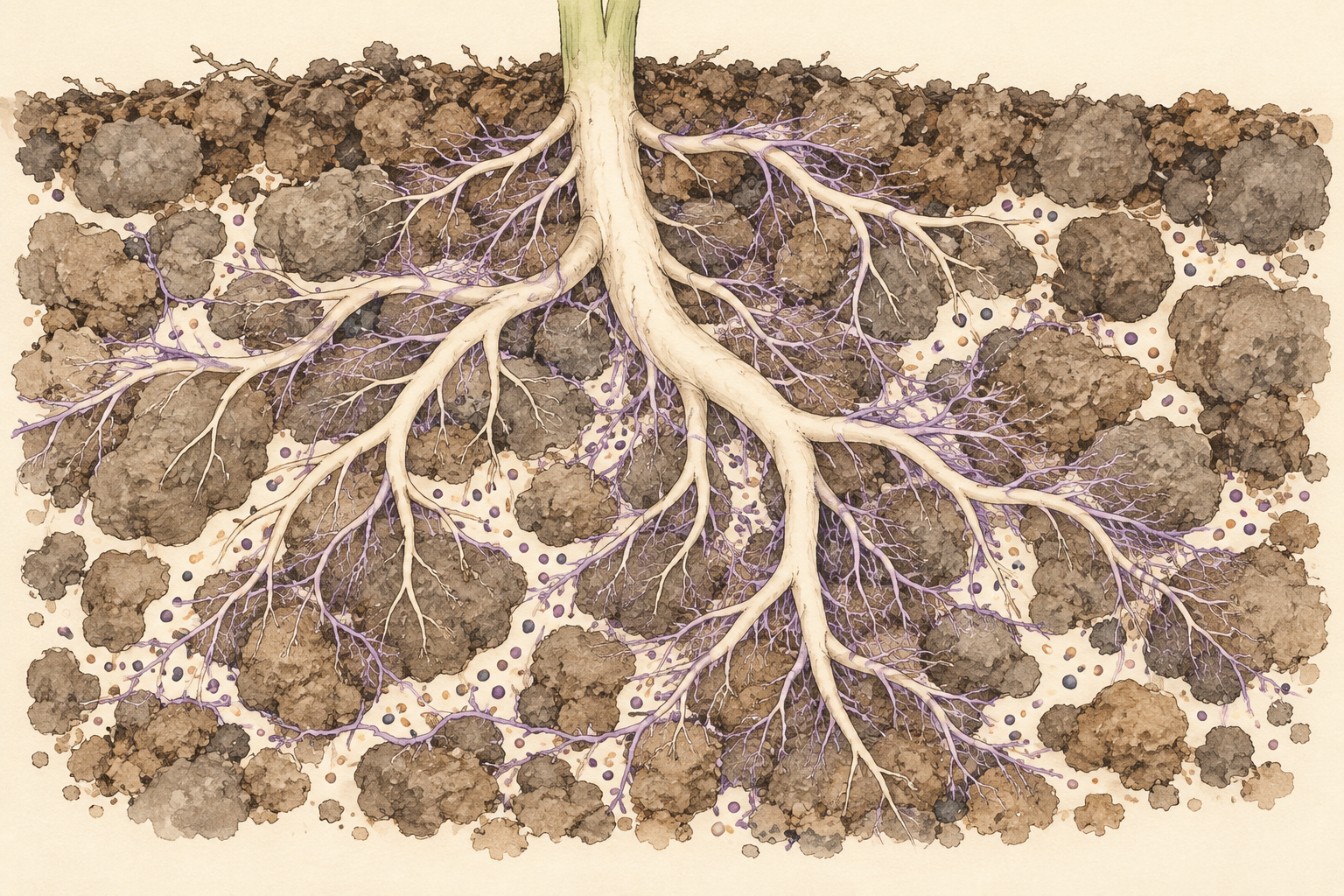
Release carbon compounds into the surrounding root zone.
Participate in decomposition and nutrient cycling.
Some fungi form partnerships with roots; others have different functions.
Let water and air move through the medium.
More than “add microbes.”
The rhizosphere is the active zone around roots. Organisms there interact with the plant, organic matter and each other. Decomposers and mycorrhizal fungi do not all perform the same function. Nor is every soil organism beneficial.
A suitable habitat matters: moisture, aeration, organic matter and growing conditions influence microbial activity. An inoculant cannot substitute for addressing a waterlogged root environment.
Before you add something, write this down.
- What medium is in the pot, and what has already been added?
- How are you deciding when to water?
- Does the container drain as intended?
- What organism or ingredient does the product actually declare?
- What application and storage instructions accompany it?
One useful comparison at a time.
Record the starting conditions. Keep a comparable untreated group where practical. Change one input, record observations on the same dates, and keep unexpected results too. A photograph of a healthy plant alone cannot tell you which input caused the result.
KICKOFF in your routine.
Use the KICKOFF product page and current feeding chart for product-specific guidance. The quantity planner treats its application separately from liquid feeds, so increasing liquid-feed frequency does not multiply its weekly amount.
Go to the source.
Soil biology · University of MinnesotaSoils and plant nutrition · University of MissouriReviewed 8 October 2026 · General growing and ingredient research.
How we separate research, measurements and product guidanceGo deeper into living soil.
Life below the surface · Why organic growing still involves pH