
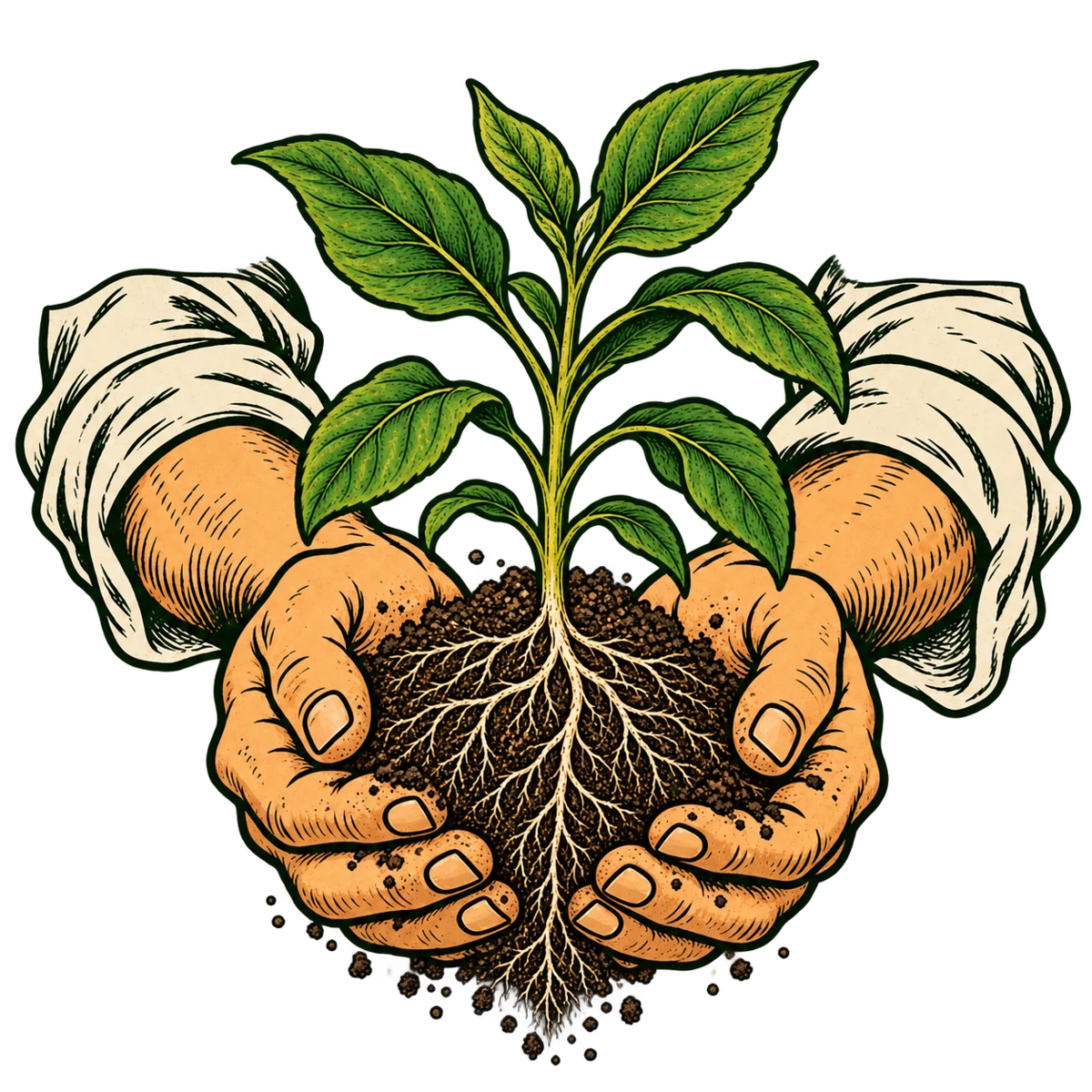
Start with the whole plant
Plants use light, water and carbon dioxide to build sugars and new tissue. Roots take up water and nutrients. Leaves, roots, stems and flowers each have their own job, and they depend on each other.
Light, temperature, humidity, airflow, genetics, container size, irrigation and root health all shape growth. When something changes, look at the whole grow before changing the feed.
Roots need water, nutrients and air
Roots absorb water and dissolved nutrients and need oxygen to work. A root zone that stays soaked, dries unevenly or builds up salts limits uptake even when nutrients are there. A symptom above the soil isn’t automatically a deficiency.
Start with the medium
- Living soil: an active environment. Check what it already supplies.
- Prepared substrate: check its starting charge. A light mix and a heavy mix aren’t the same start.
- Coco and soilless media: delivery matters more. Use guidance for that medium.
pH is one part of water quality
pH is the water’s current acid–base state. Alkalinity is its capacity to neutralise acid. Two waters at the same pH can respond very differently once feed goes in. Water also carries minerals and salts a pH pen can’t see.
Elements do different work
Plants need macronutrients in larger amounts and micronutrients in small amounts. More of one element doesn’t automatically mean better growth, and too much of one can block another.
Organic and mineral
Mineral programs supply nutrients ready to take up. Organic growing supplies many through materials that biology transforms first. Many grows mix both. We formulate around organic inputs because we care about plant-derived materials and living soil. Mineral growers can add ÉLAN to an existing program without converting the grow.
Know what kind of product you’re using
- Base nutrition supplies the core plan.
- Supplements add particular nutrients.
- Biostimulants support plant processes; they aren’t complete feeds.
- Beneficial biology adds specific organisms to the root zone.
Observe first. Diagnose second.
- Note what changed and when.
- Check the root zone, watering and environment.
- Review the water and product rates.
- Change one thing at a time and record the result.
A chart is a starting point
Start with the current chart for your products and medium, follow the label, watch your plants, and change gradually when there’s a reason. Start low. Read your plant. Then climb.
Read the research
- Plant nutrients and their functions · University of Florida IFAS (SS737)
- Soils and plant nutrition · University of Missouri Extension (G9077)
Reviewed 8 October 2026. Research cited here explains plant science in general; it is not a trial of a Crazy Hills product. How we handle evidence.